Education
Shilajit vs. Ashwagandha: Which one Is Right for You?
Two ancient remedies. Two different mechanisms. Choosing the right one starts with understanding what your body actually needs.
- May 22, 2026
- 9 min.
- Purevie Editor
Introduction
The adaptogen market has a problem. Most brands lump everything together as if one size fits all - as if every depleted, exhausted, overstressed person needs the same thing.
They don't. Shilajit and Ashwagandha are both powerful. Both rooted in Ayurvedic tradition. Both backed by growing clinical research. But they operate on completely different biological pathways, and using the wrong one is like reaching for the wrong tool.
The question isn't which is better. It's which one your body actually needs right now.
The short version
- Shilajit works primarily at the mitochondrial level - restoring cellular energy through 84+ minerals and fulvic acid
- Ashwagandha works primarily at the hormonal level - regulating cortisol and calming the stress-response system
- They target different root causes: depletion vs. overwhelm
- They can be taken together - they act on complementary pathways without conflict
What's the Real Difference?
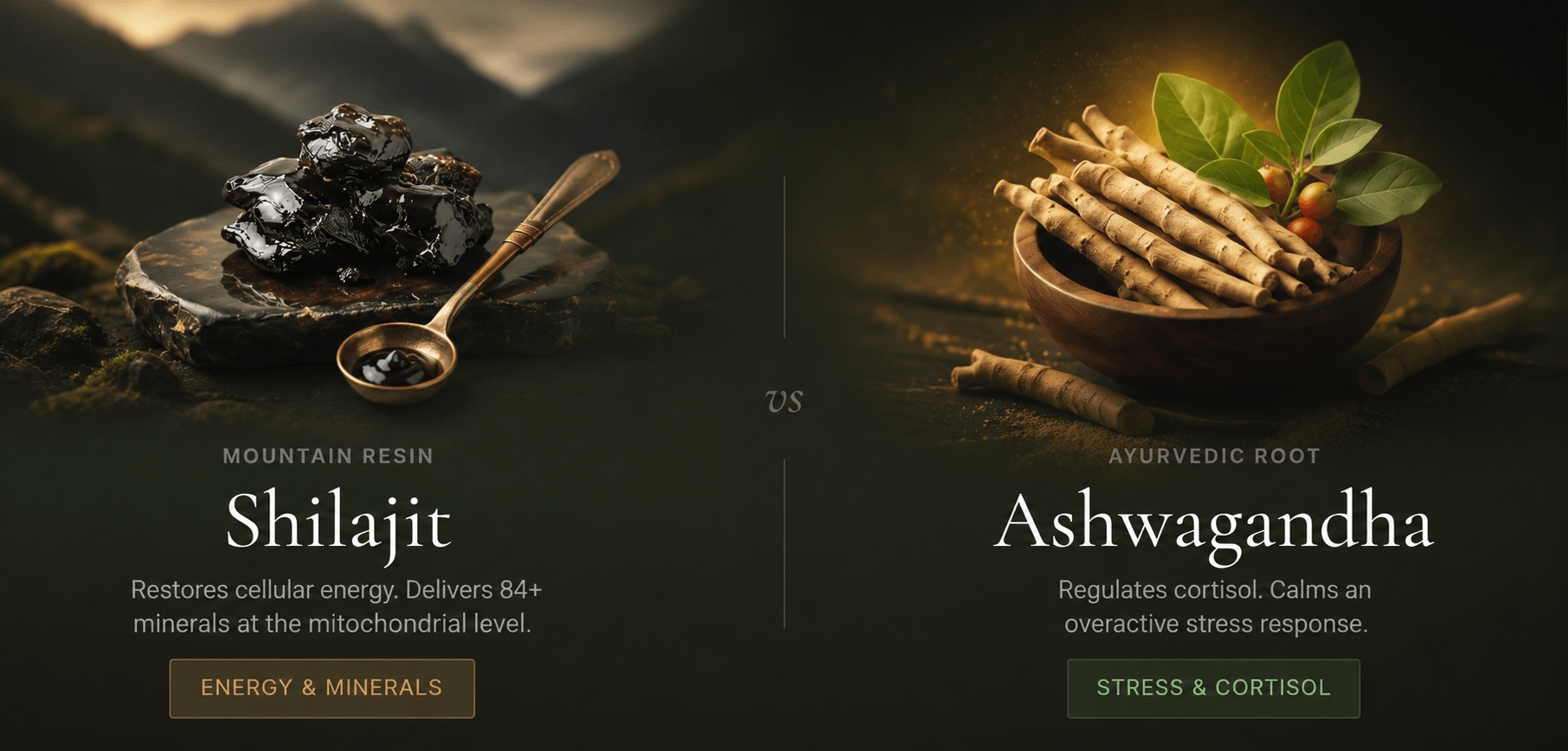
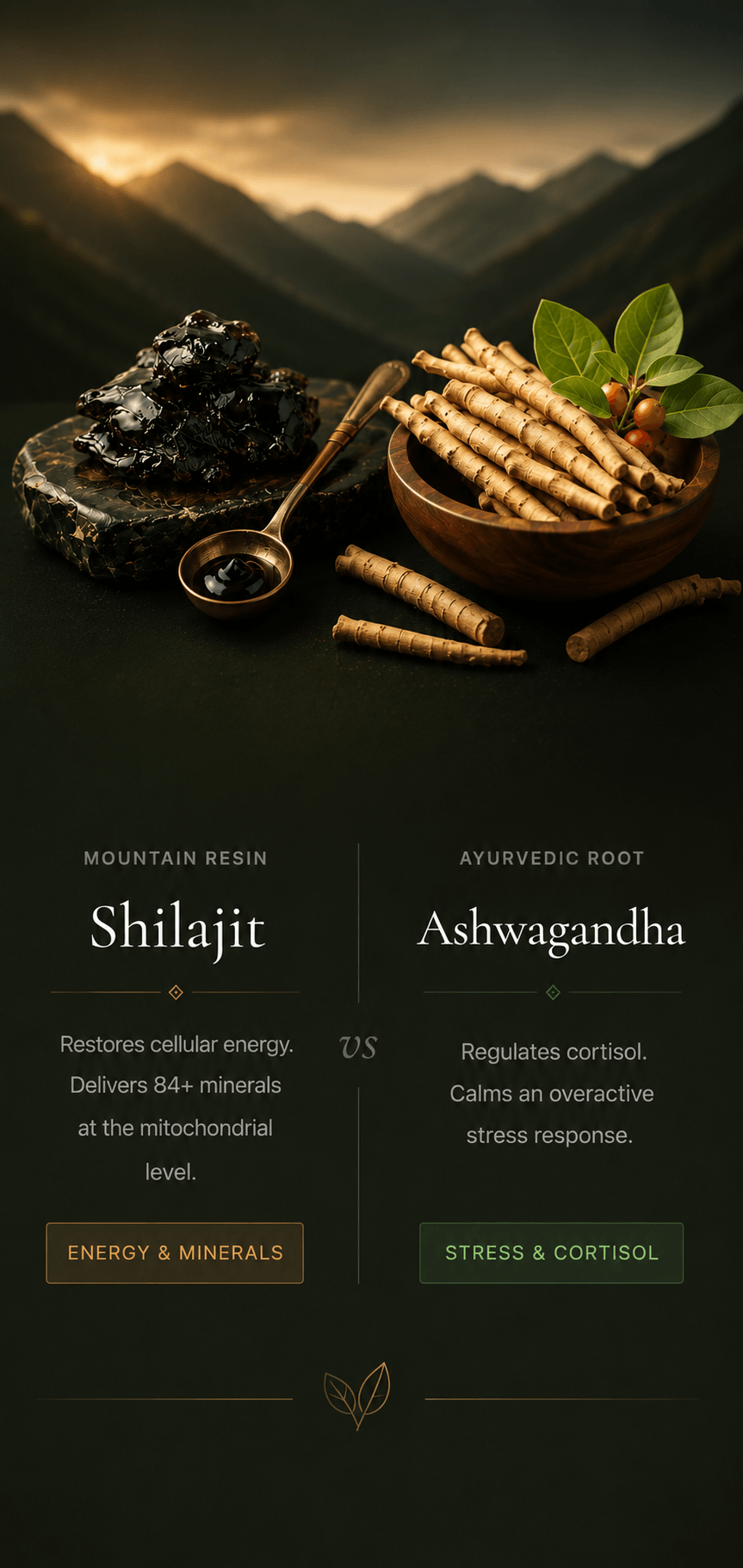
Shilajit is not an herb. It's a mineral-dense resin that forms over thousands of years as organic plant matter decomposes under the pressure and cold of high mountain ranges. The result is a concentrated substance containing over 84 trace minerals in ionic form, bound together by fulvic acid a compound that helps ferry nutrients directly into cells.
Ashwagandha (Withania somnifera) is an evergreen shrub whose roots have been used in Ayurvedic medicine for millennia. Its active compounds, called withanolides, interact directly with the body's neuroendocrine system specifically the HPA axis to modulate how your body responds to stress.
Diagnosing your core need is the starting point. Are you depleted of resources, or are you overwhelmed by stress signals? The answer points clearly to one or the other.
Mountain resin
Shilajit
ENERGY
Primary mechanism
Mitochondrial ATP production
Key bioactive
Fulvic acid & 84+ ionic minerals
Main benefit
Cellular energy & mineral replenishment
Best for
Deep fatigue, burnout, depletion
Results felt
Often within days to 1 week
Ayurvedic root
Ashwagandha
Stress
Primary mechanism
HPA axis & cortisol regulation
Key bioactive
Withanolides
Main benefit
Stress & anxiety reduction
Best for
Overwhelm, wired-but-tired, poor sleep
Results felt
4–8 weeks of consistent use
How Ashwagandha Manages Stress
Ashwagandha's primary role is to act as a modulator for your body's stress-response system the Hypothalamic-Pituitary-Adrenal (HPA) axis. When you're chronically stressed, your adrenal glands produce excess cortisol. Over time, elevated cortisol disrupts sleep, depletes energy, and creates the particular kind of exhaustion that doesn't improve with rest.
Ashwagandha doesn't suppress your stress response entirely it helps bring an overactive system back to equilibrium. A 2024 systematic review by Arumugam et al. found that ashwagandha consistently reduced cortisol levels and perceived stress across multiple clinical trials. A landmark study in Cureus (Salve et al., 2019) found subjects taking a high-concentration ashwagandha root extract showed significantly reduced serum cortisol compared to placebo.
Its two key actions: regulating cortisol via HPA axis modulation, and enhancing GABAergic signalling the brain's natural calming pathway. Ashwagandha doesn't give you energy. It helps you stop wasting energy on an overactive stress response.c
"Ashwagandha doesn't give you energy. It helps you stop wasting energy on an overactive stress response." Purevie
How Shilajit Targets Cellular Energy
Shilajit operates at a more foundational level: the mitochondrion. Your mitochondria are the energy-producing structures inside every cell responsible for converting food and oxygen into ATP, the body's primary energy currency. Modern stress, poor nutrition, and ageing all impair mitochondrial function, leading to persistent, deep fatigue.
Fulvic acid, the key active compound in Shilajit, acts as a catalyst in this process. It helps electrons move more efficiently along the mitochondrial electron transport chain - the core process of ATP generation. Research reviewed in Phytotherapy Research (Stohs, 2014) found that fulvic acid supports mitochondrial energy and protects these cellular engines from oxidative damage.
Enhanced ATP production
Fulvic acid improves the efficiency of the mitochondrial electron transport chain - more energy from the same input.
84+ ionic minerals
Essential cofactors for thousands of enzymatic reactions, delivered in a bioavailable ionic form your cells can use immediately.
Mineral transport
Fulvic acid chelates and carries minerals directly into cells - improving absorption from food and other supplements too.
Antioxidant protection
Shilajit's components protect mitochondria from oxidative damage - a key driver of cellular ageing and energy decline.
Shilajit doesn't manage stress. It rebuilds the very foundation of your body's energy supply.
Purified Shilajit Resin
Shilajit sourced from the high-altitude mountain regions of India. Purified the traditional Ayurvedic way.
- £19.99
- 20g Jar
Shilajit Honey Sticks
Responsibly sourced Shilajit blended with organic honey, sealed in 30 individual daily sticks. Tear it open. Take it and done.
- £24.99
- 30 Sticks
Can You Take Both Together?
Ayurvedic tradition
A classic Ayurvedic pairing
Combining Shilajit and Ashwagandha is a recognised practice in Ayurvedic tradition used together to build Ojas, or core vitality. Ashwagandha turns down the alarm. Shilajit refills the fuel tank that stress depleted.
No conflict
They work on complementary pathways. Ashwagandha manages the neurological and hormonal perception of stress. Shilajit provides the raw materials minerals and metabolic support for your body to physically recover and adapt. There is no negative interaction between them.
A review of Ayurvedic Rasayanas in the Journal of Ayurveda and Integrative Medicine (Pandit et al., 2015) confirms this kind of combination is a common traditional approach to achieving more holistic balance.
If you experience both deep fatigue and chronic stress a very common scenario stacking them is a logical approach. Start with one, observe for a few weeks, then consider adding the other.
Which One Is Right for You?
if your main issues are…
Choose Shilajit
- Deep physical or mental fatigue that sleep doesn't fix
- Slow recovery after exercise or illness
- Feeling generally run-down or mineral-depleted
- Low energy that's consistent across the day, not spiky
if your main issues are…
Choose Ashwagandha
- Feeling wired but tired - anxious or overwhelmed
- Difficulty sleeping due to racing thoughts
- A strong reaction to daily stressors
- Mood instability linked to stress
Honest Trade-offs
No supplement is without nuance. Both deserve honest consideration before you start.
For Shilajit, the primary challenge is quality. The market is saturated with low-grade powders and counterfeit resins. Authentic, high-potency resin has a strong, bitter, earthy taste a genuine sign of mineral density. Always choose a product with a clearly stated sourcing origin, purification method, and lab testing. At Purevie, our resin is sourced from the mountains of India and purified using classical triphala concoction, as described in the traditional Ayurvedic text Rasatarangini.
For Ashwagandha, the main consideration is time. Its effects are cumulative and typically take four to eight weeks to fully emerge. Some people experience mild drowsiness initially as cortisol adjusts - which is why many prefer taking it in the evening at first.