Education
What Genuine Shilajit Looks Like vs What to Avoid?
The Shilajit market has a problem that most brands selling Shilajit would prefer you didn't know about. Here's what it is - and how to protect yourself from it.
- May 08, 2026
- 9 min.
- Purevie Editor
Introduction
Shilajit is not easy to source well, and it is not easy to purify properly. It requires a specific geographic origin, a careful extraction process, and proper purification before it is safe to consume. None of that is cheap or convenient.
Which is why a large portion of the Shilajit products available online particularly on major marketplaces are not what they claim to be. Some are diluted. Some are contaminated. Some are processed using industrial shortcuts that strip out much of what makes genuine Shilajit worth taking. And because Shilajit is still relatively unfamiliar to most UK consumers, most people don't know what questions to ask.
This article changes that. Here are five signs the Shilajit you're buying or considering - may not be the real thing.
The 5 Warning Signs
1. No sourcing information anywhere on the product or website
Genuine Shilajit comes from specific high-altitude regions - primarily in India (the Himalayas, Ladakh, and Uttarakhand), and parts of Central Asia. Reputable producers know exactly where their Shilajit is sourced from, because sourcing is a core part of quality control.
If a product page or label makes no mention of where the Shilajit comes from - if it simply says "Shilajit" with no geographic reference - that's a significant warning sign. There are only a few plausible explanations, and none of them reflect well on the producer.
2. No purification method mentioned
Raw Shilajit, as it is collected from rock faces, is not safe to consume. It contains heavy metals, free radicals, and other impurities that must be removed through a proper purification process before the product reaches you. This is not optional. It is a requirement.
Classical Ayurvedic purification uses a triphala concoction - a process referenced in traditional texts including Rasatarangini AFI-I. Modern industrial processing uses chemical solvents. The method matters, both for safety and for the final composition of the product.
A product that makes no mention of how it is purified has almost certainly not been purified transparently. At worst, it may not have been purified properly at all.
Purified Shilajit Resin
Shilajit sourced from the high-altitude mountain regions of India. Purified the traditional Ayurvedic way.
- £19.99
- 20g Jar
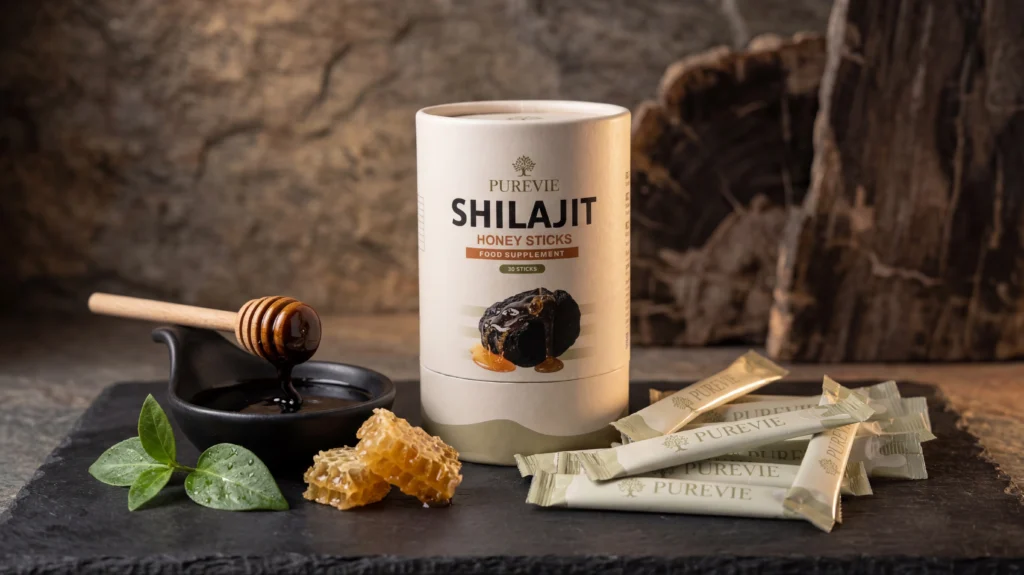
Shilajit Honey Sticks
Responsibly sourced Shilajit blended with organic honey, sealed in 30 individual daily sticks. Tear it open. Take it and done.
- £24.99
- 30 Sticks
3. A long list of fillers, additives, and "other ingredients"
Genuine Shilajit resin has one ingredient: Shilajit. That's the entire list. If you're looking at a Shilajit product - particularly a capsule or powder - that lists magnesium stearate, microcrystalline cellulose, silicon dioxide, rice flour, or similar compounds, those are fillers. They are there because the actual Shilajit content has been diluted.
Fillers are inexpensive. They add bulk and reduce the amount of the active ingredient needed per serving. A long ingredient list in a Shilajit product is not a sign of sophistication. It is a sign that you are not getting a full serving of Shilajit per dose.
4. No manufacturing certification or verifiable licence number
A reputable Shilajit product is manufactured at a GMP-certified facility - Good Manufacturing Practice - with a valid, verifiable manufacturing licence. This is not a marketing badge. It is a regulatory requirement that confirms the facility meets specific standards for safety, hygiene, and quality control.
If a product has no mention of GMP certification, no manufacturing location, and no licence number, there is no independent verification that it was produced under controlled conditions. The licence number should be on the label. If it's not, the certification may not exist.
5. The price is implausibly low
Responsibly sourced and properly purified Shilajit is not cheap to produce. Sourcing from high-altitude regions requires specialist knowledge and local partnerships. Traditional purification is labour-intensive. GMP-certified manufacturing adds cost. Batch testing adds cost.
A Shilajit product that costs £5 or £8 for a month's supply has cut corners somewhere. The question is only which corners, and how many. Price alone is not a quality indicator - but price that is dramatically below market rates for a responsible product almost always tells a story.
What Genuine Shilajit Looks Like vs What to Avoid
Warning signs
- No sourcing location stated
- No purification method mentioned
- Multiple filler ingredients listed
- No manufacturing licence or GMP
- No batch testing confirmation
- Price significantly below market
- Sold by unnamed overseas marketplace sellers
What to look for
- Specific geographic sourcing stated
- Purification method clearly described
- One ingredient: Shilajit only
- GMP-certified facility + licence number
- Batch testing confirmed
- Realistic pricing for the quality claimed
- A brand you can contact and verify
Why quality matters?
There are two reasons the quality question matters more for Shilajit than it does for many other supplements.
The first is safety. Raw Shilajit contains heavy metals. Unpurified or improperly purified Shilajit can expose you to lead, arsenic, and other toxic compounds at levels that are not safe for regular consumption. This is not a hypothetical risk - there are documented cases of heavy metal contamination in Shilajit products. Proper purification eliminates this. Improper purification doesn't.
The second is efficacy. If you have tried Shilajit and noticed nothing no shift in energy, no change in recovery, nothing the most likely explanation is not that Shilajit doesn't work. It is that the product you tried was not genuine Shilajit in the meaningful sense. Diluted products produce diluted results. In some cases, no results at all.
A note on capsules vs resin: Capsule format Shilajit is significantly more likely to contain fillers and lower actual Shilajit content than resin. The resin format - the traditional format - has a single ingredient, is visually inspectable, and gives you a clearer picture of what you're actually taking. If you're new to Shilajit and unsure which format to choose, the resin is the more transparent option.
How to Research a Shilajit Brand
Based on everything above, here is a simple framework for giving Shilajit a genuine evaluation:
Where is it sourced?
The answer should include a specific region, not just "the Himalayas" in vague terms. Look for a brand that can tell you the area and ideally the altitude.
How is it purified?
Traditional triphala concoction purification is the classical method. Industrial chemical extraction is faster and cheaper. Both are described differently ask if it's not stated.
What is the manufacturing licence number?
If a brand lists one, you can verify it. If they don't list one, ask them directly. The answer or lack of one will tell you something.
Is there batch testing?
Quality Shilajit producers test each batch for purity, authenticity, and heavy metal content before it ships. Some make certificates available on request. Ask for one.
Can you contact a real person?
Brands that stand behind their product make it easy to ask questions. Brands with something to hide make it difficult. A working email address and responsive customer service is a basic indicator of legitimacy.
On Purevie's sourcing and quality: Our Shilajit is sourced from high-altitude mountain regions of India. Purified using classical triphala concoction as per Rasatarangini AFI-I. Every Purevie product is made at Anmolveda Wellness Private Limited, New Delhi (AYUSH, GMP and ISO certified). Licence number (DL - 489 A&U). Every batch is quality tested before it ships. One ingredient. Nothing added.
The Bottom Line
The Shilajit market is genuinely difficult to navigate as a new buyer. The terminology is unfamiliar, the claims can be difficult to evaluate, and the visual difference between genuine and diluted resin is not always obvious to an untrained eye.
But the checklist is simple: sourcing, purification, ingredient list, certification, testing. A product that can answer all five clearly is worth considering. A product that can't answer any of them is not.
Shilajit has been used for over a thousand years for good reason. What it isn't is magic and what no amount of good marketing can compensate for is a poor quality product. Buy it right, or don't buy it at all.